
BOOK 2: ROLLING AWAY THE STONES
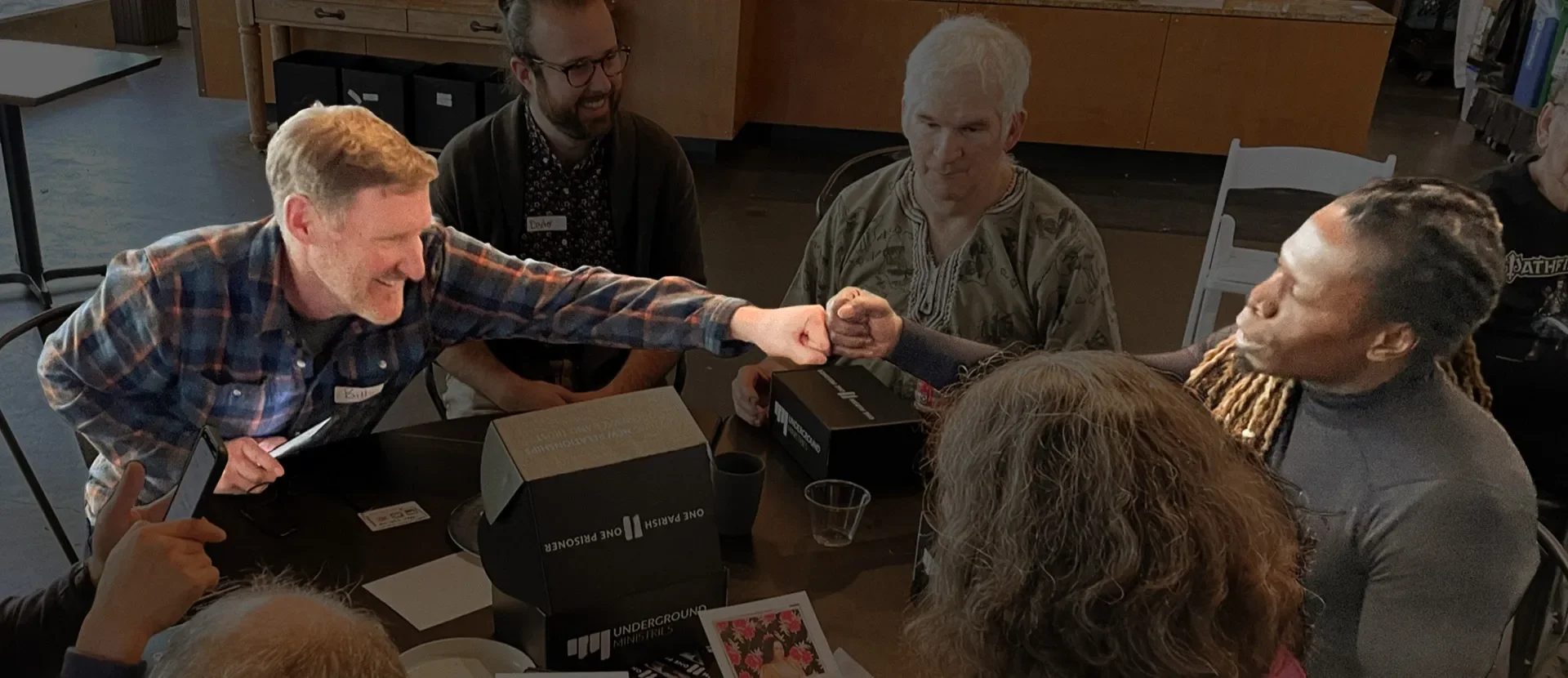
Building a personalized plan together.

This month we’ll begin two key pieces of reentry planning.
First, we’ll introduce our Stones & Layers model for building a holistic, personalized reentry plan with our friend.
Second, we’ll focus on the first issue under the “Stones” list: Release Housing.
BUILDING A REENTRY PLAN—TOGETHER
If you came to our Kickoff Orientation, you know how we at Underground Ministries frame both the spiritual mystery of the divine work of transformation in all of us, and the social work mechanics of prison reentry — all within the story of Lazarus’ resurrection.
There are so many pieces to reentry planning that all the details can be overwhelming. Framing it all in this resurrection story—Jesus raising Lazarus from the tombs, and a community helping roll the barriers away—helps us see the simple power of what we’re doing.
It also keeps our focus on the larger miracle of resurrection that God is initiating, which we can’t force. It reminds us that a mystery is happening in the darkness between God and our incarcerated friend (yes, even if our friend does not have a recognizable belief system or prayer life), and that we are invited to draw close and join the miracle.
This image of Lazarus’ resurrection also helps us view all the reentry barriers — housing, courts and case numbers and debt, driver’s license requirements, appointments, parole officers, employment, and more — as one simple image: these are just the heavy stones to roll away from America’s tomb system.
At Underground Ministries, we’ve been refining a tool, to keep track of the reentry details of each individual we work alongside, while not losing sight of the larger story.
This tool also helps the releasing friends we’re working with make a plan that:
Starts with their deepest sense of call and desire to a new life,
Identifies all the “stones” and barriers we’ll be working to roll away together,
While also addressing the old protective “layers”—addictions, toxic relationships, false identities—that have protected them in the dark, but now need to be shed.
Let’s practice those three movements: Their desires and sense of call and vision is what drives them forward. We just help roll away these stones, embodying Jesus’ embrace as they emerge. Together, we name and unravel the protective layers we all have that hide our true selves.
Have your team’s convener reach out to us (dexter@undergroundministries.org) to take a look at the Stones and Layers page that your friend filled out when they applied to One Parish One Prisoner. This is your template for building a personalized, holistic reentry plan.

A letter from Underground Ministries’ Lead Reentry Navigator Alex, about his experience with the Stones and Layer form:
I remember when I first got the Stones and Layers form. I was incarcerated at Walla Walla State, six years in with four more to go. A lot of my time was in the hole and I had lots of opportunity to think about my life, what I had done with it, and how I wanted to be different after getting released.
But all those damn checkboxes really stressed me out—a whole list of things I had to do, taunting me, and I didn’t know how to do any of them. My first thought was, “Fuck it, I’ll just go back to hustling—I know how to do that and then I don’t have to worry about this shit.” The thought of handling responsibilities in my life was real scary to me. I would rather continue to hide behind my persona, continuing to hurt myself and others. That’s fear talking.
I didn’t know how to do any of the things on the Stones and Layers form: getting a driver’s license, going to the municipal clerk and facing the actual dollar amount of debts and fees I owed, working out child support, finding an employer to take a chance on an ex-convict. All of that is tough, and the layers are harder—dealing with my anger, stress, addiction, shame, self-doubt, wanting to run away to the hustle again.
The thing is, I released from prison, addiction, and gang life. That’s three big transformations. I had to move away from three different worlds into an entirely new one. I didn’t know how to do it alone, so I didn’t. I had people who had been there before, ready to receive me on the other end. They walked with me to those places and knew which questions to ask, who to talk to, how to get things moving. I did my part in this, leaning on my trusted community to help walk me back to life.
It was eight years ago that I first looked at the blank Stones and Layers form while in prison. I’ve been able to check off every single box on there, with the help of my community. Today, I’m a loving husband, father, uncle, and brother. I’m a college student. I work full-time at Underground Ministries. My family has their driver’s licenses, vehicles, insurance, checking accounts, employment, education, love, trust, community, and communication.
I’m writing to tell you that you can do this. I’ve been there and I hated it, but there’s a way to the other side. Facing this form is the first step, and you’ve got your OPOP team waiting to help and learn together. Do it, step by step, for you.
Alex S.
Direct Reentry Navigator
Underground Ministries
IT TAKES A TEAM

A One Parish One Prisoner team at their first in-person meeting with their released friend (smiling without the mask) during COVID, after over a year of letters, calls, and reentry planning together.
As you look at the “STONES” list of common reentry barriers on the form, you’ll see that there’s no way one person can handle all of these on their own:
Housing
Immigration
Probation/Supervision
Sex Offense Registry
ID / Social Security Card
Transportation/Driver’s License
Court Debt, Collections
Drug & Alcohol Treatment
Employment
Medical / Mental Health Needs
Child Support Payment / Custody of Children
The structures blocking a resurrected life from fully breaking out of the underworld are immense – that’s why Jesus called a community to come roll away that huge stone over Lazarus’ tomb.
All hands on deck to roll these stones away! It will require every member on your team rolling up their sleeves and taking on these barriers.
In next month’s module, we’ll show you how we break these down into 5 roles. Each team member can choose one and get a page of specific guidance about their role.
Housing will be one.
But this month, before one person takes the lead on this reentry barrier, we are inviting you all as a team to learn about it.
-
Chicago area One Parish One Prisoner teams have the tremendous advantage of partnering with Kolbe House Jail Ministries. Take a minute to reach out to your parish team and make sure you are looped in with our friends there.
Say hi to Kolbe House via phone: 773.247.0070
or email: info@kolbehouseministry.org
Mention that you’re preparing for the reentry process with your OPOP team. Schedule a chat, a group visit, etc. Some of your parish team members may already be part of Kolbe House!
QUICK QUESTION
HOUSING
When facing release from prison, the most basic question for every incarcerated person is: Where am I gonna live? What’s my release address?
We are about a lot more than just finding an address, and most One Parish One Prisoner incarcerated applicants are in a different frame of mind, too: focused on finding the right housing that supports their healthy reentry and gives them the best chance at starting their new life.
Note: RSO is the abbreviation used for individuals on the Sex Offender Registry. These folks will require RSO-friendly housing. If this is your incarcerated friend, start familiarizing yourself with the housing restrictions they’ll face – for example, they cannot live within 500 feet of a school, park, or daycare.
COMMON RELEASE HOUSING OPTIONS
You as a team can help your person think through, contact, and secure one or two good housing situations, starting now. Here are the most common options to present and discuss with your releasing friend.
Live With Family - This isn’t as easy as it sounds. Many folks leaving prison don’t have good relationships with family members. Sometimes starting a new, sober life means breaking away from the environments that helped put them in prison. Family members’ addresses are sometimes not approved by a DOC house inspection (for example, if current house residents have felony charges, firearms, known drug activity, etc). Your friend may have a romantic partner offering their home as a release address option, but your friend feels conflicted about whether that’s really the best way to start their new life. You’re not the parent or boss. Just ask good questions, like a good friend would.
Maybe a family situation is just right. You can help communicate with the family and build a relationship with them. Ask if it’s OK to visit the home/family. Invite the family member or loved one to a team meeting to help them feel embraced and supported as well.Oxford Houses - These clean-and-sober group houses are in most counties. There’s no staffing, no sign out front. They are resident-run, like Twelve Step meetings. The only conditions are a strong commitment to addiction recovery and paying rent (usually around $500/mo). There are random UAs (urine analyses), required Twelve Step meetings, and house meetings.
But there are wait lists, and applying from prison is tricky. If your friend wants to pursue this option, you can locate local Oxford Houses on OXFORDVACANCIES.COM, mail your friend the application form, and facilitate their “reentry application” to get on a few wait lists months before release.KEY: many Oxford Houses assume the only way a reentry applicant can pay rent is if they have a Housing Voucher for the initial down payment and first month. Be sure to tell your contact at the local Oxford house—and your friend, to tell their in-prison counselor—that the One Parish One Prisoner team will help cover rent costs IF there’s no voucher. The prison system and Oxford Houses don’t often see people releasing with support from a place like Underground Ministries, so you may have to explain your team’s readiness to pay the deposit ahead of your friend’s release date. That first couple months rent is is a major “stone” blocking the reentry process—a stone your church can help roll away.
Recovery or Transitional Home - Many communities have local residential recovery programs. These are usually non-profits with a strong addiction-recovery (and often faith) focus. Your friend may be turned off by a home with a manager and structured program. Or your friend might feel that’s exactly what they need —to grow, have a stable and sober environment, with daily support and structure to thrive.
Start asking around: Who knows of good recovery homes, good housing programs or transitional housing? It’s a great chance to get to know your community more, learn about good work happening close to you. Follow reliable word of mouth recommendations; steer clear of fundamentalist outfits that have a hyper-controlling feel or poorly maintained facilities. Delegate one person on the team to learn more, and another to be an intermediary between your friend and potential housing options —for photos, applications, advocacy, to help be taken seriously as a candidate.
Please click below for housing info specific to your state.
-
In most cases, Washington DOC provides a housing voucher for up to six months at approved residences. Ask your friend if they will receive this.
Also note: If your friend is releasing to a Work Release program ahead of their official release date –part of WA’s growing Graduated Reentry program– make sure to read the Work Release segment below.
-
Halfway Houses (90-day stays, assigned and paid for by IDOC):
Cornerstone: (773) 909-2424
- Serves men
- Private recovering community—specializes in the treatment of alcoholism, opioid addiction, substance abuse, and mental illness
Hand’n’Hand (RSO-friendly): (773) 722-1312
- Serves men
- Provides around the clock staff, meals, NA/CA/AA meetings, workshops, job training and placement referrals, substance abuse and mental health assessments
Recovery/Transitional Houses within Cook County:
St. Leonard’s House (West Loop) - St. Leonard’s Ministries provides interim housing and supportive services for formerly incarcerated men and women returning to the community from Illinois prisons. Program participants come to Saint Leonard’s House to find a safe environment in which they can develop skills to rebuild their lives and reshape their futures.
Inner-City Muslim Action Network (IMAN) - IMAN’s Green ReEntry Housing Program works to implement IMAN’s overall mission of health, wellness, and healing by making its leadership homes spaces that encourage the success of its residents by providing safe housing, structured programming focused on mental, emotional, and spiritual development, and the tools, and resources to create a life vision and a pathway to attain it.
Oxford House - Chicago site: 773-424-6029 / 5441 S Wood St.
-
TDCJ can provide housing assistance to folks about to be released. Your county may have access to vouchers and rapid housing resources, but there is not enough for everyone. Lots of folks coming out of TDCJ end up at THAP (Temporary Housing Assistance Program) or RRC (Residential Reentry Center). Your incarcerated friend can ask TDCJ staff about these resources and what to expect in the coming months.
Why not have the One Parish One Prisoner team/church offer a place to live?
It’s a good question. When we first started our One Parish One Prisoner experiments, our hope and assumption was that every church has someone with a spare room or downstairs apartment or something to rent. What better way to serve someone coming home from prison than to provide them with housing?
Here’s the problem: There’s too much power in being someone’s landlord. It puts you in a bind: you need to enforce basic standards of behavior, which they might fail. And if they relapse into an addiction or fail to pay rent, you are no longer the one they can come to for mercy and support–you’re the landlord/enforcer they’re trying to avoid. Months of deep relationship building go out the window.
That said: Please do NOT offer your releasing friend housing within your church congregation or One Parish One Prisoner team members.
Who pays early rent?
For the upcoming WELCOME HOME EVENT, you’ll be putting together the ROLL AWAY THE STONE FUND, and this is the primary purpose of that fund: covering the first 2-3 months of rent for release housing.
Once you’ve worked with your friend to locate good housing, apply for it, and get accepted, your team can pay rent for the first month to save your friend’s spot and secure a RELEASE ADDRESS. A second and third month can be paid for too, if needed. Per the One Parish One Prisoner model, we don’t cover more than three months of rent. After this, your friend’s first employment checks should be rolling in .
This brings us to a preview of the second most urgent question facing folks releasing from prison:
EMPLOYMENT
There is a whole module on employment coming up, but it’s helpful to get a preview of the One Parish One Prisoner approach to employment now, to consider as a team and with your friend.
We at Underground Ministries have always strongly encouraged releasing men and women NOT to rush into full-time employment right away.
Yes, we’re aware this goes against all the voices in society and prison that have yelled at them for years: “Get out there and get a job!”
But this is actually a cruel and unrealistic demand to make of men and women who have only just stepped out of the prison walls and are still buried under so many civic barriers.
REENTRY IS A FULL-TIME JOB
Getting back on your feet, doing reentry, rolling away the many stones to set up your life in modern society is a full-time job the first month – and that’s if you’re quick!
There are probation appointments with your parole officer, drug and mental health evaluations to schedule and attend. You’re enrolling in health insurance, getting your social security card, reopening relationships, sorting out financial obstacles. You’re finding transportation to get to all these appointments. You’re studying for your driver’s license, paying for the exams and relicensing fees, paying off old courts’ holds on your license. You’re stressing about all of this, trying to keep dates and times straight in your mental calendar—all while trying to find a job?
This is a wild gauntlet of services and schedules and finances to navigate – something most of us could barely manage if we were just stepping out of prison with nothing.
This is why so many releasing friends never really emerge from the underground: they’re forced to cut corners, skip appointments, leave court matters unresolved, all because they got a 50-hour-a-week job just to pay rent and afford all the fines they face.
The incredible anxiety, intimidation, and overwhelm of this situation leads many men and women to quickly disappear back into the shadows, often returning to their familiar drug for self-medication and numbing within a week or two.
Are you starting to understand why people go back to prison so fast? Why recidivism is so high?
Over our years of accompanying folks through reentry, we have found a better way. Rebuilding your life, adjusting, resurrecting does not happen overnight.
It takes time to attend treatment classes, work on your priorities, keep mental health appointments, exercise regularly, spend time with your kids, have time to read, rest, process emotions, and meet with your One Parish One Prisoner team.
We go slow. We are here to walk with them.
The financial support from the Roll Away the Stone Fund allows our friend to accomplish this more important reentry work and not have to rush into full-time employment.
Meanwhile, your team can consider potential employers to hire your person part-to-full-time when they are ready, and when they have their driver’s license.
We also encourage teams to line up some “side jobs” ahead of time—piecemeal, under-the-table work at the church building or in someone’s garden – a day or two a week, to get some small, dignified income.
WORK RELEASE/REENTRY OPTIONS
-
If your person has been admitted to a work release program – wonderful! That means they spend up to six of their last months in prison in a high-custody “house” closer to home, where they are expected to get a job and work all day. This helps our friends adjust to life outside prison facilities and get some work experience and structure going, while earning money to pay off some program expenses and save up a bit of a nest egg in their last month or two.
Here’s some alterations to the plan:
With that nest egg of money they’ll have saved, they may be able to pay a deposit and first months’ rent at their next housing location. That’s a great use of their earnings! You should still fundraise as a parish for the “Roll Away the Stone Fund” since there are many other costs they’ll face:
Move-in expenses at a new apartment/home
Medical bills
Debt
Insurance
When our friends complete Work Release, they are often itching to keep working full time, contrary to our recommendation of easing into part-time work. It’s hard to convince someone finally out of prison and finally working to hit the brakes and slow down a little! With these friends, we need to remind them of a few things:
Though they’re in Work Release, commuting to work, and probably feeling great, they aren’t “out” yet. Many of our friends finish work release successfully, only to fall flat on their faces without the rigid structure and monitoring work release provided for them. Full release, the freedom to go anywhere whenever is a major adjustment… and it’s hard. “Don’t get overconfident,” we say. “There’s still a challenging road ahead.”
When they complete work release, they will likely have to do drug and alcohol treatment/evaluations, mental health evaluations, work on getting their driver’s license, etc. If they’re working full time, when will they be able to do all this reentry work?
Sometimes this reality sinks in, and we help them talk to their employer about getting one day off each week (a shortened schedule) for a few months. Having every Tuesday to schedule meetings, get to appointments, work on their license, etc. makes a world of difference.
You can figure it out together. Just have these conversations ahead of time – as a team. -
OPOP Chicago has the good fortune of living in a state that is paying a lot of attention to reentry. For several years, coalitions and resource libraries have been building a process that was accelerated during the pandemic due to increased need.
Here are two great, comprehensive resources we recommend starting with:
Mapping Your Future: A Guide to Successful Re-Entry
Published by the Education Justice Project at the University of Illinois, this guide is a goldmine for practical steps before and after release, including forms, links, and organization strategies. Read through it yourself and please print out a copy for your incarcerated friend.
This online community was built to create easy channels of communication between releasing individuals and service providers. Our incarcerated friends can create a profile and start growing their network of service providers in their specific areas of need.
IDOC also provides some assistance to releasing folks. It can vary a bit by facility, but generally your friend should have access to a Reentry Room, which has a variety of resources and a Field Services Rep (FSR) who meets with them within 30 days of release. Your friend can gather resources and start to clarify what to expect in the coming months. -
TDCJ Resource Guide: https://www.tdcj.texas.gov/documents/rid/RID_Reentry_Resource_Guide.pdf
Travis County Resources: https://www.reentryroundtable.org/get-help/Bexar County Reentry Service Center - Resources for individuals releasing from a period of incarceration, or on probation or parole.
Chrysalis Ministries can help with IDs, preparing a resume, interview skills, job leads, work clothing, and transportation. Chrysalis, along with Catholic Charities and St Vincent de Paul, also offers support for families during and after a loved one’s incarceration.
THEY ARE WORTH IT
Our releasing friend is not just a cog in a utilitarian society. They are a fully human being coming back to life on the outside. They are worth all this work, and worth taking it slow. Keep reminding your friend of this. It’s at the heart of God-made-flesh in your team.
ACTION STEPS
PRINT AND MAIL this module, and a fresh Stones and Layers form, to your friend.
START THE HOUSING CONVERSATION WITH YOUR FRIEND: Ask what their initial ideas are. Ask what kind of environment they think will need to start the life they’re seeking.
LOOK INTO LOCAL OXFORD HOUSES AND RECOVERY/TRANSITIONAL HOMES
Brainstorm at your team meeting – it’s good for everyone to start asking around, getting a feel for the (lack of) housing options for people leaving the underground in your community.
PRAY with your friend for wisdom in identifying and connecting with the best housing option.
FOR TEAM DISCUSSION
What do you already know about your person’s housing ideas? Make that the topic of conversation in letters and calls this month. Ask questions. Let their desires lead.
Can you take photos, learn more info, share with your incarcerated friend and be a collaborative support for their decision?
Look over the Stones and Layers document. What can you pencil in based on what you’ve learned about your person’s dreams, goals, barriers, and fears? Use a pencil, as what we learn is always evolving in these categories. Make one shared copy to build on in the months to come.
FOR REFLECTION
