
BOOK 4: BEARING WITNESS TO THE RESURRECTION
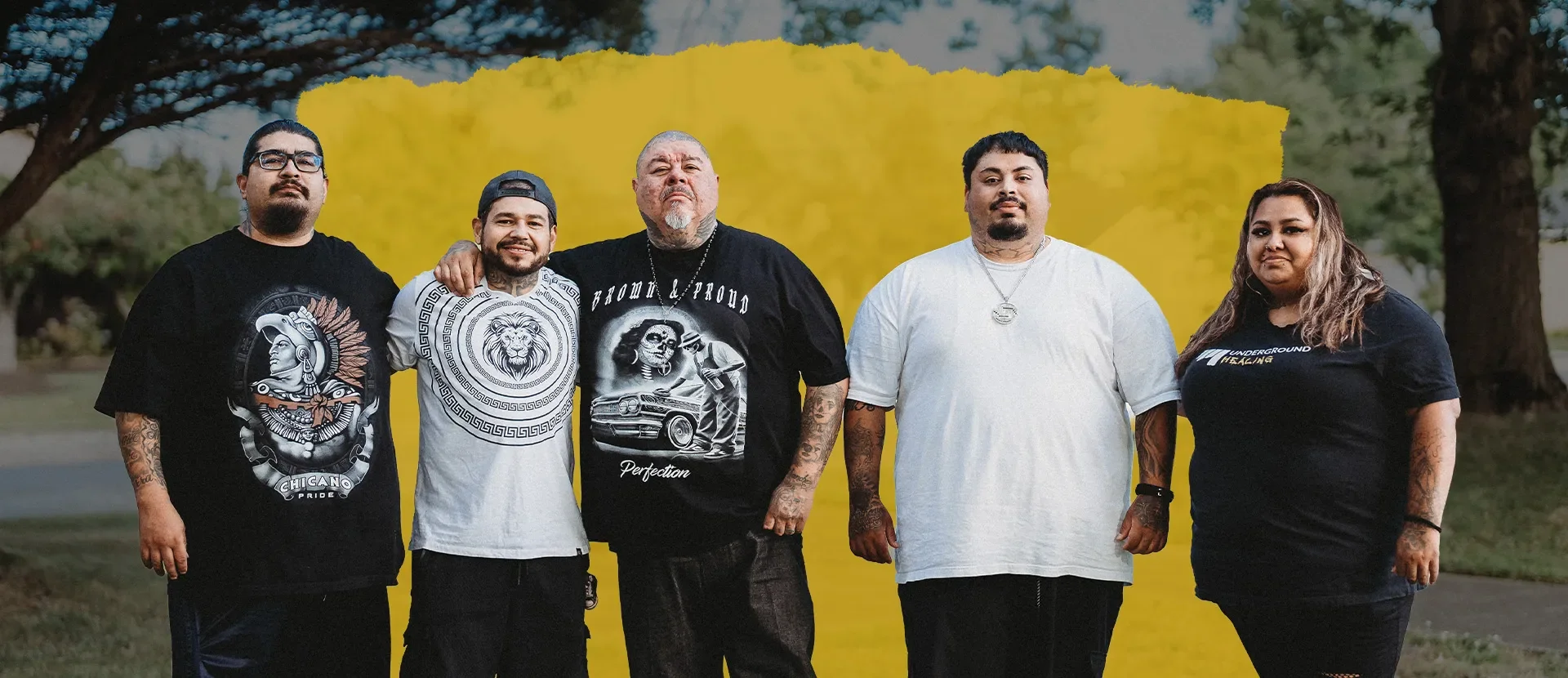
Letting go of what destroys and renewing our imagination of God’s justice and restoration.
Maybe throughout this journey you’ve been scratching your head as a team, asking “Is this really the best we can do as a society for incarcerated people?”
We believe at Underground that real change happens first through relationships. We don’t adjust our worldview because someone gives us new facts or arguments. Relationships are the realities that form us. That’s why we work to “open new relationships between the incarcerated and the communities to which they return.”
Now, with over a hundred OPOP teams launched into these journeys of relationship, reentry and resurrection, we hear how many folks in churches and communities on the outside have organically come to question the entire criminal legal system.
Shirley, a wealthy white woman on an early OPOP team texted me one night, “Chris, I watched the movie Shawshank Redemption tonight, and I just wept. That old man who finally gets out of years in prison, but has no community there for him, and is all alone and hangs himself—he needed an OPOP team! EVERYONE getting out of prison needs this. I just never knew, until we loved Willy. I want to do everything I can now, to help more people get to know one beloved brother or sister in prison.”
Shirley now uses her education and executive skills (with the ferocity of a mother) to accompany their released friend Willy through medical insurance tangles, mental health appointments, housing officers and treatment waitlists. She sees that Willy — and millions of others who have released from prisons — are rarely able to navigate these systems to survive unless they have a community connecting all the broken pieces. “I now see why so many people go back to prison, or their old lifestyles on the streets. They don’t want to be criminals. That’s not the problem.”
The prison system and law and order beliefs can all be so abstract. “Criminals” can be a category, not human beings, not neighbors; a category we can easily dispose of, or think deserving of what we assume is a working “justice” system.
But then you love one person.
You hear their specific experience in a specific prison. You walk with them through probation appointments, you see their journey and hope for healing. You are cheering for them, you pray for them: to reunite with their child, to get their housing and driver’s license and a job. Then you see a massive system that seems to prevent these prayers being answered at almost every step.
Now, almost two years into your relationship and resurrection work, it’s time to re-think the larger mythology and system of incarceration in America.
This module is a short introduction to some new concepts. So many wonderful movement leaders, thinkers, and organizations have led the way, and we’re sharing some of the books/videos/solutions they have been working on. Think of this module as a trailhead, with lots of trails extending from it to lifelong areas of study you can explore individually, or as a team or church.
Start with the comic-article below – it’s called Who’s Left, created by Mariame Kaba & Flynn Nicholls – and let’s explore this month’s biggest question.


THE GATES OF HADES
Remember at your Kickoff Orientation when we talked about Jesus starting his church (ekklesia) as a movement which “the gates of Hades cannot stop”?
“And I also say to you Peter, upon this rock I will build My church; and the gates of Hades will not overpower it.”
— MATTHEW 16:18
Hades is the realm of the dead. It’s a spiritual map for any society: where we bury or exclude or contain those who are “dead” to us. Separated from the land of the living. At Underground, this is the deepest reality of the American prison system: not safety, not justice, not “corrections,” but a system of social death. And that Jesus’ core mission is not to justify the system of death, but to break it open and bring new life.
Together, your letters and calls and prayers have penetrated the many gates and walls of the “underworld/hades/hell” of prison to make contact with someone whom God loves. You’ve gotten inside this intimidating prison system and, through release planning, have seen how many barriers exist for a branded “sinner/criminal/felon” re-entering the land of the living.
You’ve seen firsthand how thick the gates of Hades really are.
Jesus challenged the structures, law, and norms of his time. He announced a different world, the kingdom of God. He used dozens of stories and analogies to help us imagine a different way of orienting human relationships.
If Christians in America today are ever going to reimagine our criminal legal system, it’s going to happen when people like you, who’ve come to care for one person in that system, start asking questions and prayerfully imagining a different way.
So this month we are giving you lots to read and think about. Set aside some time for this. We believe it’s exciting, difficult, prophetic reading (and listening).
REMOVING OUR OWN LAYERS
Maybe some of what you read below will feel off-putting, unrealistic, or out of sync with your politics. That’s ok. We don’t grow by only hearing what we already believe.
This is part of identifying our own layers. It’s not just folks resurrecting from the tombs who have grave clothes to unwrap, old mindsets to remove. We all grew up with cultural norms that both blinded and protected us. There are laws and worldviews we never questioned until we experienced their destructive consequences.
In this way, we’re constantly inspired and challenged by individuals rebuilding new lives after prison: their courage and humility to let go of old belief systems — about, for example, gangs, how to treat women, how to handle money, or conflict, or children — and be open to learning entirely new ways of seeing the world.
Can we be inspired to do the same?
PRISONS DON’T WORK
Until We Reckon: Violence, Mass Incarceration, and a Road to Repair by Danielle Sered
Mass incarceration simply doesn’t work, argues Danielle Sered in this essential treatise on better forms of accountability and safety. Our current “justice” system does not make our communities safer, nor does it bring healing to victims and survivors most hurt by violent crime. As the author points out: “If incarceration worked to stop violence, we would have eradicated it by now — because no nation has used incarceration more.”

Soak that basic argument in. If prisons made us safer, wouldn’t the leading prison nation in the world, America, also be nearly crime-free by now?
Ms. Sered directs Common Justice in Brooklyn, one of the nation’s leading and successful models of “restorative justice”: alternative legal responses to crime that don’t prescribe punishment and warehousing but rather a series of responses a city can make to rectify the harm caused by the crime.
What if our cities and governments made restoration — God’s vision throughout all scripture — the goal of our justice system?
In Sered’s words: “Restorative justice… allows us to envision a justice system that is not just smaller, but is truly transformed into a vehicle for accountability, safety, and justice that everyone deserves.”
Sered directs Common Justice in Brooklyn, one of the nation’s leading and successful models of “restorative justice”: alternative legal responses to crime that don’t prescribe punishment and warehousing as “justice,” but rather a series of responses a city can take to restore the harm caused by the crime.
What if our cities and governments made restoration—God’s vision throughout all scripture—the goal of our justice system?
“Restorative justice . . . allows us to envision a justice system that is not just smaller, but is truly transformed into a vehicle for accountability, safety and justice that everyone deserves.”
— Danielle Sered
READ THE BOOK’S INTRODUCTION, below.


SO, WHAT’S THE ALTERNATIVE?
Often, the folks we know in gangs stay in the gang life because they haven’t been shown a different way of handling conflict, hardship, danger. It’s all they’ve known, what they were raised with. It’s no different than those of us who were raised with the current culture of policing, prosecution, expensive prisons, and probation offices. Too often, we just don’t know any alternative. “How would we be safe”, we ask, “without this policing-and-prison system? How would we hold people accountable for crime and wrongdoing? How would we have justice?"
Those are beautiful questions.
A simple starting point is asking: What do we really mean by justice?
Do we mean punishment? That’s “punitive justice.”
Do we mean accountability for harm, care for victims, and making right the relationships and trust that were wounded? Can we do this in community? That’s what we call “restorative justice.”
Guess which kind of justice our criminal legal industry is based on?
RESTORATIVE JUSTICE
In this short video, Rev. Dominique Gilliard introduces some of the basics of Restorative Justice.
Instead of asking the Punitive Justice questions at the foundation of our current courts:
What law was broken?
Who broke the law?
What is the appropriate punishment?
Restorative Justice asks,
Who was harmed, and how?
Who is responsible for the harm?
How can the harm be repaired?
Who are the parties responsible for helping lead the process of repair?
How can the harm not be repeated, with a plan of accountability?
Thankfully, Restorative Justice is no longer a fringe alternative practiced by a few holy fools at a few nonprofits with innovative programs in a few local courts. Restorative Justice and Practices are growing in school disciplinary departments, juvenile courts, and even modelling alternative legal avenues in adult court systems across America.
PUNITIVE JUSTICE
Retaliation | Episode 3 | The Zo | The Marshall Project https://www.youtube.com/watch?v=iYHaAMYOXhU
This is the third and final installment of a series we began in earlier modules.(The transcript is available at the end of the module.)

A CALL FOR THE CHURCH TO LEAD
Rethinking Incarceration: Advocating for Justice That Restores by Dominique DuBois Gilliard
Rev. Gilliard is a pastor and theologian whose heart longs to see Christ’s church not be the last ones on board for works of righteousness and justice — but rather, to lead the way.
For this challenging module, we hope to use Pastor Dominique’s theological vision and heart as our guide into the other readings that follow.
READ THE BOOK’S INTRODUCTION, below.


QUICK QUESTION
ABOLITION?
Do you feel the prison system and reentry barriers are helping to heal your community? If you answered “no”, you might be a prison abolitionist already.
Once upon a time, Americans took the massive institution of slavery as a norm. A few maligned radicals thought it should come to an end.
“Sure, it’s not perfect,” much of the country probably would have pushed back, “but it’s unrealistic to think slavery could just go away entirely!” Or, “What would happen to the entire economy?! Would those slaves even know how to manage themselves? It would be chaos!”
As with justice movements today, there were many groups who focused on slavery reforms instead, trying to make the institution of slavery more humane through incremental improvements.
But some people — driven by their faith and a fiery conviction that the God of the Bible, the God who delivered the people of Israel from Egypt, is consistently and passionately a God of liberation — called themselves ‘abolitionists’. They really believed society could and should function without the institution of slavery, period.
Embracing the challenging core of our Biblical faith is what we’d like to invite your team to consider at this point in your reentry journey.
The early Christian faith exploded, not as a reasonable, pragmatic outline of piety for Roman citizenship and small reforms within the empire. Rather, because of an arrested and publicly executed radical preacher among the poor and outcast distrusted and handed over to the police by his own religion’s leaders, who came back from the dead! The Resurrection was an undoing of the entire prosecution and sentencing system.
For hundreds of years, before Christianity became the status-quo religion among European leaders, the central image of Christian salvation was this:

Jesus’ Resurrection was imagined as a divine prison-break, a smashing of gates and locks that opened up a more universal abolition of Hades and Death itself, envisioned as prison-like realms. Early Christians envisioned Jesus not rising alone from Death, but welcoming all of humanity — as far back as Adam and Eve — out of captivity.
“What does it mean for us, in the most incarcerated society on the planet, that the metaphor Jesus makes central to his ministry—that comes from Jesus’ own tradition—is FREEDOM FOR PRISONERS?”
— Hannah Bowman, founder of Christians for Abolition
This is our work too.


(It’s a cheesy depiction, but you get the idea. It’s hard to find artistic renderings of these moments in the New Testament; they’re curiously underrepresented in church history.)
Saul became more than a reformer. He envisioned a much larger work of liberation/salvation (they're the same word in Greek) in the world than his own religion was comfortable with. When he and others were arrested and in prison, what happened? God shook the prison and everyone was freed! (Acts 16)
Peter was in prison around the same time and what happened? Angels broke him out, leading him right past the guards. (Acts 12)
It’s hard to read the Bible and not see a wildly abolitionist God at work, from start to finish.
Even the walls of Jericho came down nonviolently—as God’s people were armed only with music and praise of their liberating God. Paul and Silas and the apostles in prison were in prayer when the structures around them started to shake.
Fast forward a couple thousand years: Christians participating with other movement leaders in the “Underground Railroad”—networks of trusting relationships that welcomed vulnerable families and individuals out of captivity—undermined the culture supporting slavery as an acceptable norm in America.
Eventually the institution came to an end.
When Jim Crow laws were passed in the south, our faith tradition said, “no” in the form of the “radical” Civil Rights movement.
Fast forward to today: Writer, attorney, and activist Michelle Alexander has traced the rapid shift after the Civil Rights Acts to the new “tough on crime” policies and “war on drugs” laws. These regulations have turned policing, prisons, and felony records into the Jim Crow laws of today.

Throughout his movement, Jesus insisted God was calling for “release for captives” (Luke 4). This has been dismissed as only ‘spiritual liberation’. It’s common to dismiss Jesus. That’s why he often literally, physically healed people while also forgiving their sins. He didn’t just spiritually cleanse lepers, but tangibly altered their excluded status. For Jesus, spiritual liberation and literal liberation went together.
The outbreak of followers who believed Jesus broke the bonds of death went on to radically re-orient their lives, their finances, their understanding of who belongs to who. This is all recorded in the Acts of the Apostles.
A formerly violent enforcer of his religion, Saul, had a vision of God in the position of a punished criminal, and it changed him (Acts 9). He was blind and disoriented for a while. It’s common for people who’ve been in relationship with criminals to feel deeply disoriented for a period: they aren’t sure how to see God, American history, the law, the way they used to anymore. Welcome to the gospel adventure.
Alexander has called for “a new Underground Railroad.” We built Underground Ministries and specifically One Parish One Prisoner to answer that call.
After eight years of traveling and speaking about her work, Alexander decided not to return to her post in a law school, but to dedicate her future to working within a seminary!


In an interview, she described her career shift this way:
“Legal academics want to study problems in a very narrow and often data-driven way, without really asking the deeper questions around, ‘Who are we in relationship to one another? What does justice mean?’
[I am] someone who now believes that much more revolutionary change is required, and it’s not simply a political revolution.
A moral and spiritual revolution is also required of us now.”
— Michelle Alexander, 2020
Alexander’s move from legal reformer to abolitionist went hand in hand with a move to the seminary.
“I’m now interested in abolition as a spiritual practice. The Letter to the Hebrews talks about ‘evidence of things not seen, but hoped for.’
That’s abolition.”
— Michelle Alexander, 2021
IMAGINATION
“It’s time for a jailbreak of the imagination in order to make the impossible possible.”
— Mariame Kaba, We Do This 'Til We Free Us
READ THE EXCERPT FROM HER BOOK, below.
We believe this is an approach that both conservative and liberal Christians can get behind: Create local responses of healing to what the big government machine of prison cannot save us from. May Kaba’s call to imagine be our call to greater faith as the church.
Your team has already begun this creative, imaginative work: building direct relationship with someone cut off from society; establishing friendships, doing reentry together, blending your worlds. One Parish One Prisoner is part of today’s Underground Railroad, and you are a thriving part of this movement.
Next month’s module asks: “Is This Just the Beginning?” What if this program, these modules, are just the starter kit, the training wheels for your parish and former prisoner to do creative work together?

If not prisons, then what? How do we create safety, accountability, healing, and repair in our communities?
Mariame Kaba (co-creator of the comic at the start of this module) is one of the nation’s leading voices and practitioners of “abolitionist organizing and transforming justice.”
She is the first to insist that abolition is not an anarchist impulse to tear down a system. Rather, it’s a call to creatively build an alternative in our communities – better responses of accountability, safety, and health.


ACTION STEPS
Watch and read through the resources listed in this module.
FOR TEAM DISCUSSION
Try to avoid heady, abstract debates in your meeting time together. Rather, connect the readings to your situation: How do these big ideas apply to your released friend?
Restorative Justice:
What were their actions that led to arrest and prison? Who was hurt by that crime? What might the victims have needed more than someone sitting in an expensive adult warehousing center?
What community need or wound is revealed by the crime(s) your friend committed?
Church To Lead:
What might the church’s (not just your one congregation’s) role be, in helping to bring God’s healing for these kinds of crime?
Abolition:
It’s about investing in a better way. What has helped your releasing friend begin to transform their life, get the healing and support needed, and start to be part of the solution in your community?
What could the community and justice system do to better facilitate this healing and solution-building process?
ANNOUNCEMENT
We want to connect with you! As you read through the next module, “Is This Just the Beginning?”, you will have a chance to reflect on your team’s One Parish One Prisoner journey. We would like to join you in that reflection! Please reach out to Dexter (dexter@undergroundministries.org) to invite him and/or other OPOP staff to your next team meeting. The format will be a little different and we will help you through it as we prepare for the final module, “Capstone Project”.
